
- All
- Product Name
- Product Keyword
- Product Model
- Product Summary
- Product Description
- Multi Field Search
 English
Views: 0 Author: Site Editor Publish Time: 2026-09-18 Origin: Tire Report
Recently, two tire giants, Chaoyang and Sailun, issued price increase notices simultaneously, marking the arrival of the third wave of tire price hikes!
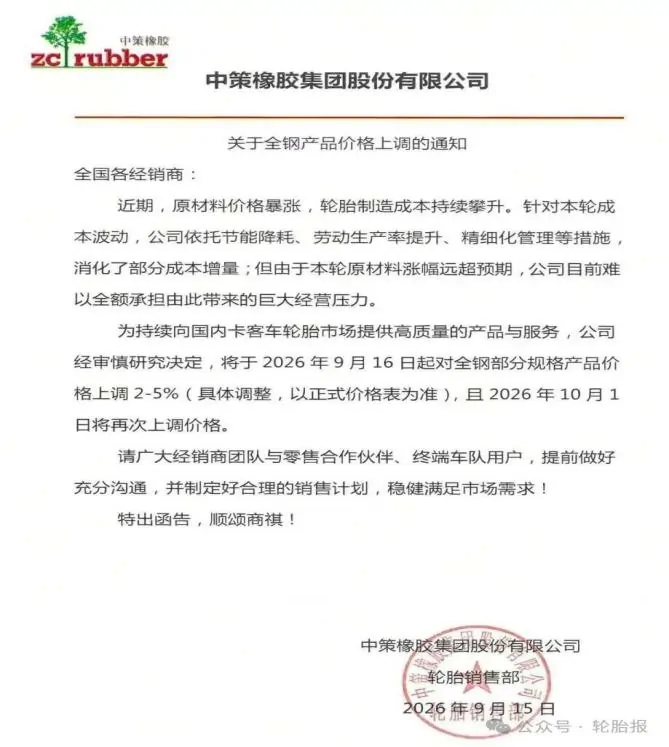
Chaoyang announced that it will raise prices of selected radial truck tire specifications by 2-5% starting September 16, with another price increase scheduled for October 1.
Sailun announced a 2-3% price rise for its TBR tires effective October 1.

Triangle Tire announced a 2-5% price hike for passenger car tires starting October 1.

Cheng Shin Rubber announced price increases of 1-5% for inner tubes, TBR tires and passenger vehicle tires between September and October.

Aeolus Tire announced a 2-3% price increase for selected TBR and OTR tire products starting September 16.

Statistics show that more than 60 price adjustment letters have been released by manufacturers including Chaoyang, Sailun, Triangle, Cheng Shin, Aeolus, Giti, Yuelong Rubber and Bayi Rubber, covering all tire categories.
Mainstream Tire Brands - Latest Price Increase Notifications | ||
Brand / Company | Effective Date | Core Price Hike Policy & Range |
ZC Rubber | From Sep 16 | Part-spec all-steel radial tires up 2-5% |
From Oct 1 | OTR tires up 3%. | |
Sailun Group | From Sep 20 | OTR tires up 3% - 5%. |
From Oct 1 | TBR tires up 2% - 3%. | |
Triangle Tyre | From Sep 1 | Commercial vehicle tires up 2% - 3%. |
From Oct 1 | PCR tires further up 2% - 5%. | |
CST / Cheng Shin Rubber | Sep - Oct | Inner tubes (Sep 1), TBR (Sep 25), PCR (Oct 1) up 1% - 5%. |
Aeolus Tyre | From Sep 16 | TBR partial products up 2% - 3%, OTR/ROTR partial products up 2%. |
Giti Tire | From Sep 27 | Price adjustment across all brand products in the Chinese replacement market. |
Wanda BOTO / Yuelong Rubber | From Sep 1 | Full product line price up 2% - 3%. |
Bayi Rubber | From Sep 2 | All product series prices up 2% - 3% |
| Fangxing Tire / Shenghai Rubber | From Sep 12 | Uniform price up 3% across full series / all-steel radial tires. |
Official agencies forecast a global natural rubber supply gap of around 280,000 tons in 2026. Output has declined in major rubber-producing countries such as Thailand, Indonesia and Vietnam. Coupled with drought in producing regions, natural rubber output falls far short of market demand.
Affected by geopolitical tensions, butadiene — the core raw material for synthetic rubber — remains in tight supply, with its price hitting a record high. This forces downstream manufacturers to switch to natural rubber as a substitute, further pushing up overall rubber costs.
Many industry giants including Chaoyang stated that the current price adjustment range is far lower than the actual rise in raw material costs. Some specifications such as all-steel tires have even put manufacturers in losses due to expensive raw materials. Companies have no choice but to issue price increase notices to pass on part of the cost pressure.
Since the price notices from multiple firms are valid through October, and further hikes cannot be ruled out, dealers and customers with procurement needs are advised to place orders and stock up in advance to cope with the upcoming price surge and maximize profit margins!
For the latest pricing and product specifications of leading Chinese tire brands such as Chaoyang Rubber, please contact us.
WHATSAPP: +86-15895239086 / Julia Zhao
Jiangsu Source Valley International Co., Ltd. -- Your One-Stop Procurement Consulting Company!
Shipping empty space in a container directly inflates your landed cost per tire. This comprehensive guide breaks down the loading capacity of a standard 40HQ container for popular TBR truck tire specifications (including 315/80R22.5, 12R22.5, and 13R22.5). It covers a step-by-step mathematical model balancing volumetric space, 30% herringbone cross-stacking density gains, and local highway weight limits for key markets like Central Asia, the Caucasus, and Chile. Furthermore, it outlines practical tire nesting solutions (Doubling and Tripling) that allow buyers to cut average ocean freight costs by up to 30% without risking tire bead deformation or damage.
Read MoreShipping empty space in a container directly inflates your landed cost per tire. This comprehensive guide breaks down the loading capacity of a standard 40HQ container for popular TBR truck tire specifications (including 315/80R22.5, 12R22.5, and 13R22.5). It covers a step-by-step mathematical model balancing volumetric space, 30% herringbone cross-stacking density gains, and local highway weight limits for key markets like Central Asia, the Caucasus, and Chile. Furthermore, it outlines practical tire nesting solutions (Doubling and Tripling) that allow buyers to cut average ocean freight costs by up to 30% without risking tire bead deformation or damage.
Read More


